


Naval affairs are rising in importance for Russia’s political leadership. Russia’s highest political authority on the subject, Nikolai Patrushev, head of the Russian Maritime Collegium and a key presidential aide, outlined the priorities of the Russian Navy for the coming decades in a coordinated media campaign.
The story begins on 3 July, when the Council for the Strategic Development of the Navy, a body of Russia’s Maritime Collegium (Морская коллегия), met to review a draft of a central official naval strategic document, currently under revision. The document is titled Fundamentals of State Policy in the Field of Naval Activity to 2050 (Основы государственной политики Российской Федерации в области военно-морской деятельности на период до 2050 года). The session was closed. The Collegium’s account of the meeting was published the same day.
Over the following twelve days Patrushev gave three interviews that together give a comprehensive view of the future direction of the Russian Navy. They were given to the Vesti news service on 10 July and to Komsomolskaya Pravda on 11 July, his seventy-fifth birthday, and to RIA Novosti on 15 July. The press release and the interviews can be interpreted as a coordinated campaign, with an objective of outlining in public the future direction of the Russian Navy.
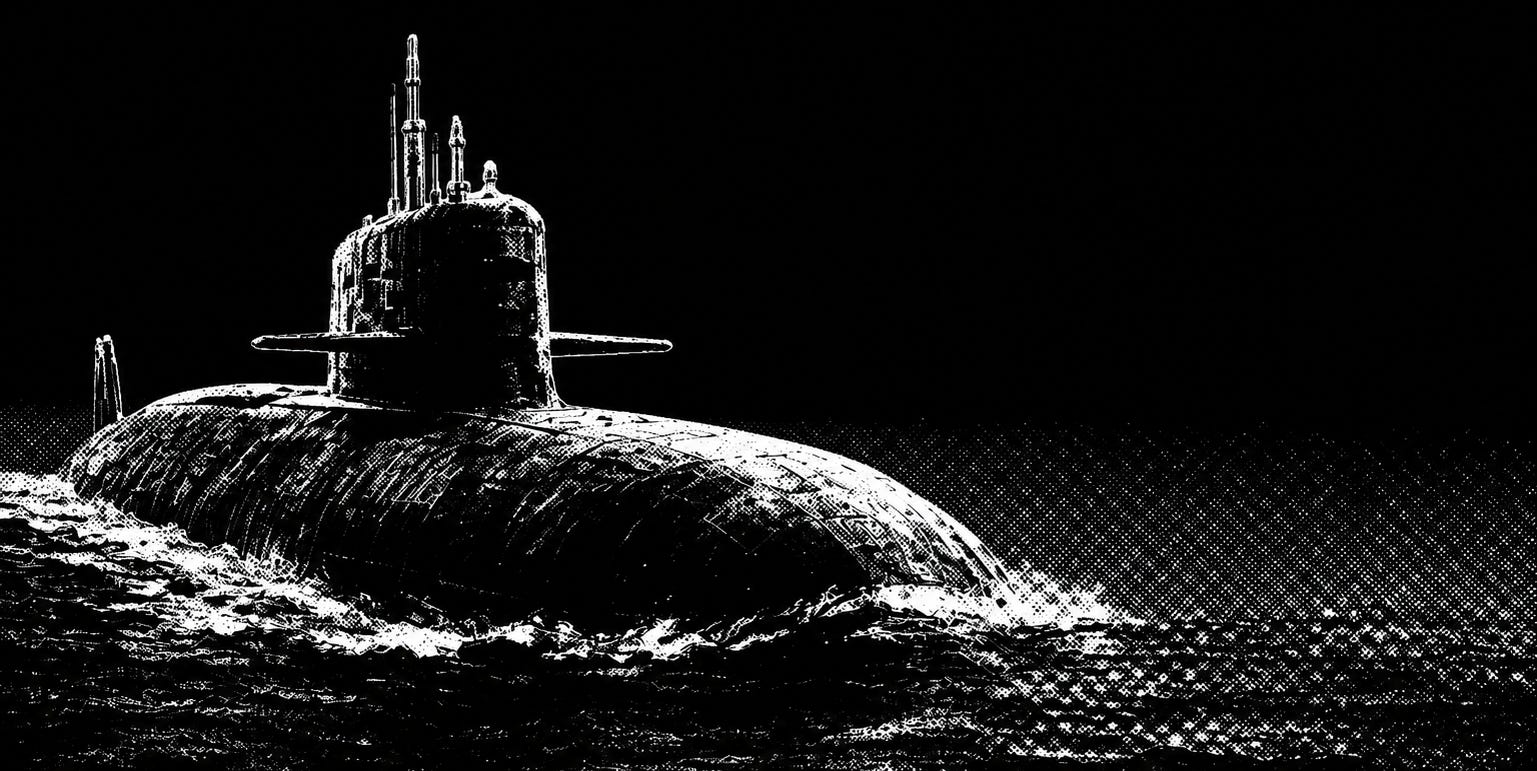
Preservation and modernisation of the nuclear submarine fleet as the basis of naval nuclear deterrence comes first, in Patrushev’s own words. Three further priorities are outlined: securing Russian energy exports along the most important sea lanes, expansion of the naval unmanned capabilities, and expanding space-based reconnaissance and targeting capabilities in support of the Navy.
Patrushev and the Maritime Collegium
Patrushev turned 75 on 11 July. Earlier he directed the FSB, then served as Secretary of the Security Council, and now chairs the Maritime Collegium as a presidential aide with responsibility over Russian maritime policy.
His background is naval-technical rather than from the Navy itself: he is a 1974 graduate of the Leningrad Shipbuilding Institute, and he worked in its special design bureau on equipment for the GRU and the Navy before entering the KGB.
Rather than direct command authority, the Maritime Collegium has a coordinating role in developing Russia’s naval power as a whole. It aligns naval, shipbuilding, shipping and Arctic policy across ministries, and the chairman carries considerable influence over its direction. Its Council for the Strategic Development of the Navy met on 3 July.
Three Strategic Documents
The interviews name three documents, which together formulate a comprehensive strategy for the development of Russian naval power and the Navy itself.
The Fundamentals of State Policy in the Field of Naval Activity to 2050 (Основы государственной политики в области военно-морской деятельности) is currently a draft. It defines the threats and challenges Russia faces in the World Ocean and sets the goals, tasks and directions for naval activity. This document will most likely be public, as its previous version from 2017 was published as a presidential decree.
The Strategy for the Development of the Navy to 2050 (Стратегия развития Военно-Морского Флота до 2050 года) is an existing plan, in which threats from probable adversaries are already factored in. This strategy was confirmed on 30 May 2025. It was the first document of its kind in modern Russia, which underlines the importance Russia currently places on naval affairs.
The naval shipbuilding programme to 2050 (программа кораблестроения ВМФ до 2050 года) is still a draft, and Patrushev said the perceived threats receive particular attention there. The finalisation of this document is likely facing challenges. Designing the future composition of the Russian Navy is especially difficult in current circumstances. The ongoing war in Ukraine and the rapid technological development of naval drones makes future projections especially hard to settle.
The development of aerial and naval drones has exposed Russia’s current naval capabilities as highly vulnerable. Giving up the larger ships is not possible either. The larger ships are required to maintain continuous presence in the world’s oceans, secure shipping and show the flag to ensure national interests and demonstrate military presence. In a conflict, however, they will be acutely exposed to drones and long-range high-precision capabilities.
Therefore the core tasks and primary needs of the Russian Navy seem to be well defined, but how they will be provided for is likely a subject of heated discussion in Russian naval communities.
Russia’s Naval Threat Perceptions
The Fundamentals document defines threats before setting requirements, and at the 3 July session Patrushev named two specific threats he wanted written into the document.
The first is regional. He said it was important to include in Russia’s list of military dangers and threats the creation of a naval alliance of northern European states and Ukraine, whose activity substantially complicates the military-political situation in the western Arctic, the North Atlantic, and the North, Baltic and Black Seas. This is an interesting formulation. Patrushev does not say NATO. It names a regional grouping of countries with Ukrainian participation, and links it to a single continuous theatre from the European Arctic to the Black Sea.
Such a structure does not yet exist as an alliance, and it is unlikely that it will be. It will likely remain as a format for naval cooperation. The interesting point is that Russia takes it seriously enough to write it into its long-term official strategic document that will far outlive the current war.
The second is AUKUS. Its work equipping the Australian navy with modern nuclear submarines, and building capacity to control shipping in the Pacific and Indian Oceans, should also count among military dangers, Patrushev said.
The Doctrinal Priorities
Judging by the Maritime Collegium’s press release, the level of Russian naval ambition is rising. The goals set in the draft of the Fundamentals document are: “strategic and regional stability” in the World Ocean, the Navy as one of the most important instruments of foreign policy, and Russia’s standing as a great maritime power.
It should be noted that in Russian thinking, the most important pillar of strategic stability is the mutual capability to conduct large-scale nuclear strikes, which prevents a direct military conflict from breaking out between nuclear powers.
These goals are to be reached through balanced development of the Russian Navy to a level guaranteeing the defence of national interests across the World Ocean and the infliction of critical damage (критический ущерб) on any potential adversary. This is achieved through modernising and expanding the naval strategic nuclear and non-nuclear forces, the general-purpose naval groupings, and by prioritising the development of unmanned systems.
Asked what should be the priorities of Russian sea power, Patrushev answered that the most important task is preservation and modernisation of the nuclear submarine fleet as the basis of naval nuclear deterrence. Asked whether that was the main priority, he called it important but far from the only one.
The other priorities he mentioned are: development of military and civil infrastructure in the Arctic; coastal defence and coast guard functions across all Russian maritime areas; a full grouping of unmanned surface and underwater vehicles; deployment of a domestic maritime reconnaissance and targeting system based on Russia’s own satellite constellation; naval presence in distant regions; naval education and science; and, above all, a balanced fleet able to handle the whole range of tasks in peacetime and war.
Patrushev argued for protecting energy exports in economic terms. Without a navy able to provide security there will be no Russia, he told Vesti, because the country would be strangled economically, and so it also needs a strong merchant fleet. His concrete example was LNG. Russia needs to carry its own gas, and the plan had been to build carriers at the Zvezda yard in Primorsky Krai under contracts with South Korea; the South Koreans refused to carry out the contracts and then refused to supply components, and Patrushev’s conclusion was that Russia must build the LNG carriers itself.
The priority of developing the Russian reconnaissance satellite constellations is based on the experiences of the Ukraine war. Russian naval authorities have continuously expressed concern because the US and NATO space-based assets and drones have given Ukraine the edge in the informational and intelligence domain in the Black Sea.
This is one of the primary lessons of the war in Ukraine, which is directing Russia to prioritise space-based reconnaissance capabilities. This is a future core capability, designed to enable Russian naval long-range high-precision strikes. Reconnaissance and targeting are recognised as some of the most important capabilities in modern combat.
The Black Sea Lesson
Patrushev seems to downplay the significance of the naval lessons from the Black Sea. He turns his view further into the future and the competition with the United States. He notes that unmanned surface vessels (безэкипажные катера) are actively fighting in the Black Sea, but then rapidly moves on to the United States, and comments that it has already launched its first unmanned ships (безэкипажные корабли).
Patrushev expects naval developments to lead to a fundamentally different reality, driven by modern technology. Unmanned surface vessels are limited by seaworthiness, autonomy and their power source; unmanned ships in comparison are capable of working in the far sea and ocean zones. Flotillas of unmanned ships, integrated by artificial intelligence and supported by drone swarms in the air, on the water and under the surface, would be a strike force difficult to counter.
Russian authorities are taking operational lessons from naval warfare in the Black Sea, but this seems to be only the first stage of development. The Black Sea is an enclosed sea, with limited ranges and operational duration. Russian authorities acknowledge the necessity of looking further into the future and developing larger unmanned surface ships to prevent Russia from falling behind in the naval domain.
Patrushev names presence in distant regions as a key task and insists the fleet must be balanced. The platforms he cites as shipbuilding successes, which he says both perform in combat and interest foreign customers, are submarines, frigates, corvettes, small missile ships and mine countermeasures vessels.
This creates a contradiction and competing priorities, since Russia must emphasise the development of unmanned systems across the air, surface and subsurface domains while continuing to build larger ships to maintain presence in distant maritime regions. Patrushev calls this balanced development of the Navy, but the competing priorities are difficult to resolve.
Concluding Thoughts
Russia continues to insist on maintaining its position as a premier maritime power, but rapidly developing technology, limited resources for developing the Navy and a weakening industrial base are likely to constrain these ambitions.
The Russian authorities may provide an accurate diagnosis of the priority tasks and problems they are facing: the fundamental national interests at stake, rapidly developing technologies, a weakening correlation of forces in European maritime zones, the lack of a technological basis for space-based infrastructure, and maritime trade corridors coming increasingly under threat.
How to resolve these issues will cause challenges for Russian authorities for years to come. There are two underlying contradictions in the development of the Russian Navy.
The first contradiction is between Russian ambitions and the actual resources they are capable of providing for the development of the Navy.
The second contradiction facing the Russian Navy is between procuring smaller unmanned naval systems for effective naval combat and the need to keep building larger and more vulnerable ships to maintain presence in distant regions of the World Ocean. The latter is essential to secure Russian national interests and to serve the ambition of maintaining the Navy as an effective instrument of foreign policy.
Even though the attention is currently on the war in Ukraine, the long-term development of the Russian Navy and Russia’s wider Armed Forces remains an important topic. The Navy seems to be increasingly prioritised at the highest political level, which indicates that significant resources will be directed to its development. This will affect the correlation of naval forces in the Arctic, the Baltic Sea and the Black Sea in the coming years and decades, which is why the topic deserves close attention. ֍
