


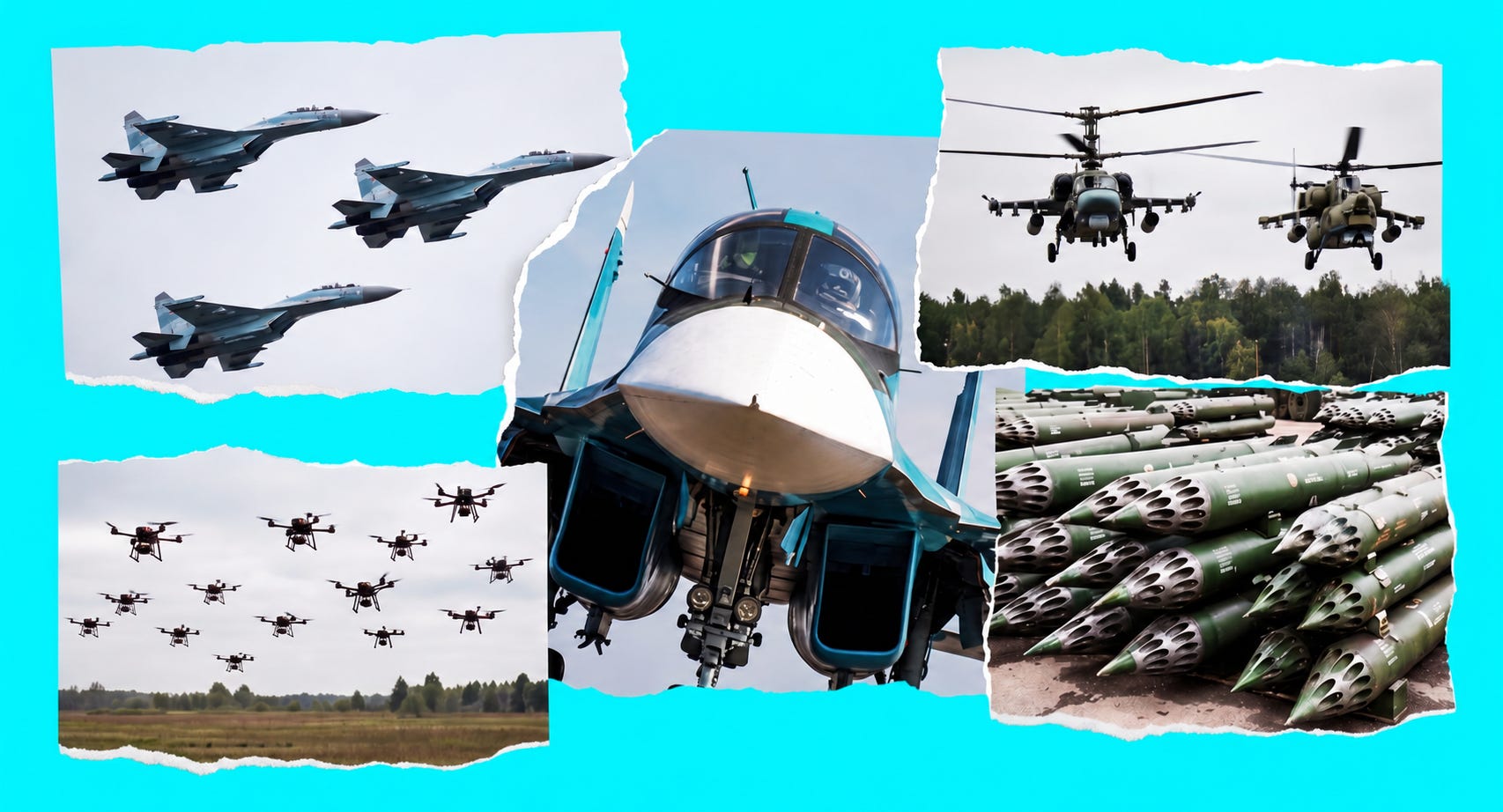
Russia’s glide-bomb campaign against Ukraine is well documented. FDD’s Long War Journal has tracked the weapons since January 2023, while Ukrainian officials say they are now being used by the thousand each month. Far less visible is how the Russian military codifies these tactics for its own officers.
An article in issue 11 of the 2025 edition of Voyennaya Mysl (Military Thought), the Russian General Staff’s military-theoretical journal, provides a rare account. Published under the journal’s military-art rubric, it describes how the Russian Aerospace Forces, or VKS, seek to attack Ukrainian targets without bringing their aircraft within range of Ukrainian air defences.
The authors are Lieutenant Colonel A. S. Afanasyev, Lieutenant Colonel A. A. Artemyev, Colonel A. N. Kochnev and reserve Colonel P. E. Ivanov. Two hold degrees in technical rather than military sciences, suggesting particular expertise in weapons employment.
Their subject is what Russian doctrine calls the ‘fire destruction of the enemy’: the use of aviation to engage targets while remaining outside hostile air-defence engagement zones. The article concludes with four broad recommendations for improving these methods.
How the mission package works
The article’s organising principle is repeated throughout: aircraft should release their weapons without entering the engagement zones of Ukrainian air defences.
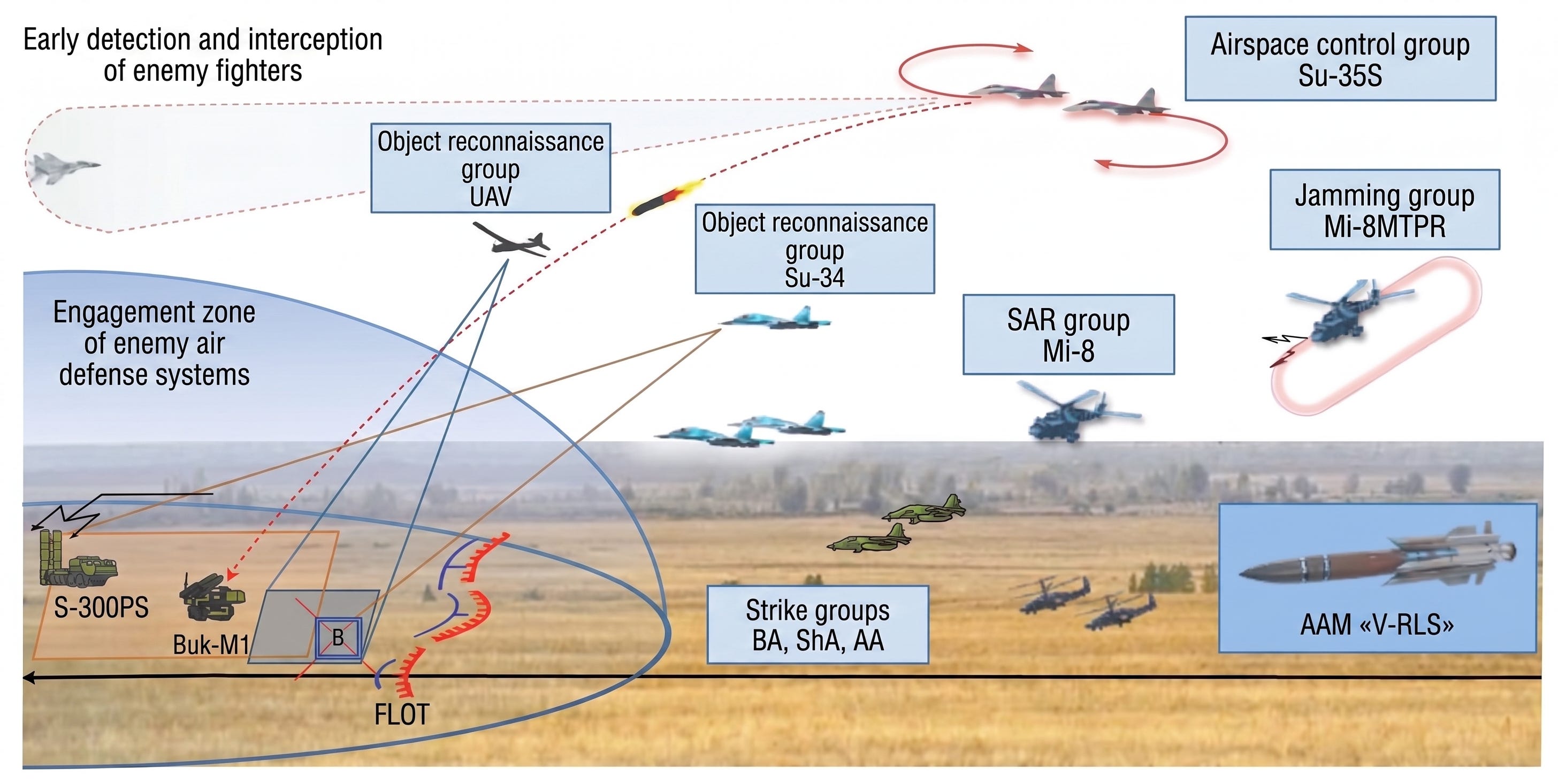
To achieve this, nearly every sortie is organised around what the authors call a tactical-purpose group (ГТН). Rather than a single strike formation, this is a combined mission package comprising:
a reconnaissance element of drones, or Su-34 and Su-35S crews using their radars;
the strike element itself, drawn from bomber, ground-attack or army aviation;
a jamming element of Mi-8MTPR electronic-warfare helicopters, which remains on station throughout the mission;
a search-and-rescue element of Mi-8 helicopters; and
an airspace-control element of Su-35S fighters carrying air-to-air and anti-radar missiles.
Together, these elements conduct a single coordinated mission.
Glide bombs and drone-designated missiles
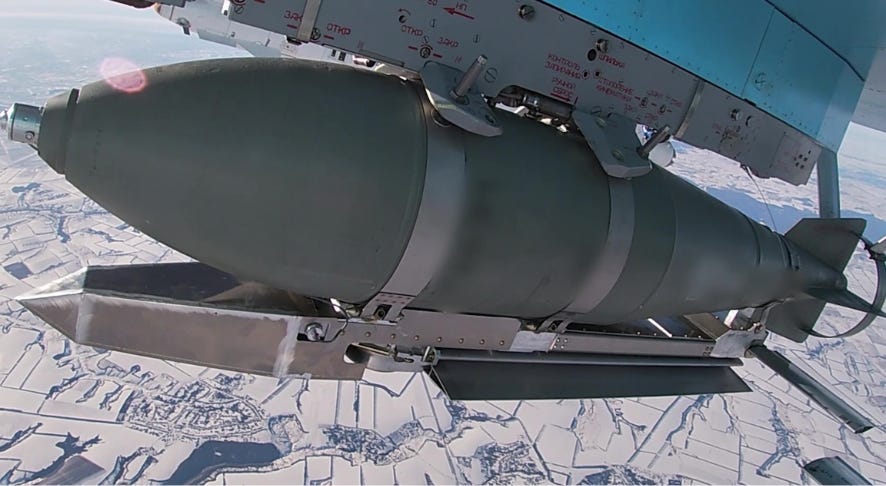
For Su-34 fighter-bombers, the authors describe a profile that has become standard. Crews approach at very low altitude over their own territory, climb briefly to release bombs fitted with the UMPK glide kit, and then turn away.
The authors give the weapon a range of up to 90 kilometres. Open-source estimates generally place standard UMPK kits at about 40–70 kilometres and extended-range variants at 80–95 kilometres. Later versions tested towards the end of 2025 may travel farther still. If the authors’ figure describes routine employment rather than a theoretical maximum, it would suggest that the newer kits have become the operational reference point.
For fixed targets such as bridges, pontoon crossings and railway junctions, the article describes a more complex division of labour. The launching aircraft does not designate its own target. Instead, a drone flying ahead provides laser illumination, allowing the aircraft to release its missile and withdraw before entering the engagement zones of Ukrainian air defences.
The authors emphasise the coordination this requires. The attack sector and launch range must be fixed in advance so that laser designation can be maintained throughout the engagement.
No independent reporting has confirmed this hand-off in Russian service. It should therefore be read as the authors’ account, rather than as established practice. If employed as described, however, it gives the drone a second role in the kill chain: not merely finding the target, but guiding the weapon onto it.
Rockets, helicopters and calculated timing
Ground-attack aircraft and army aviation are presented in similarly codified terms.
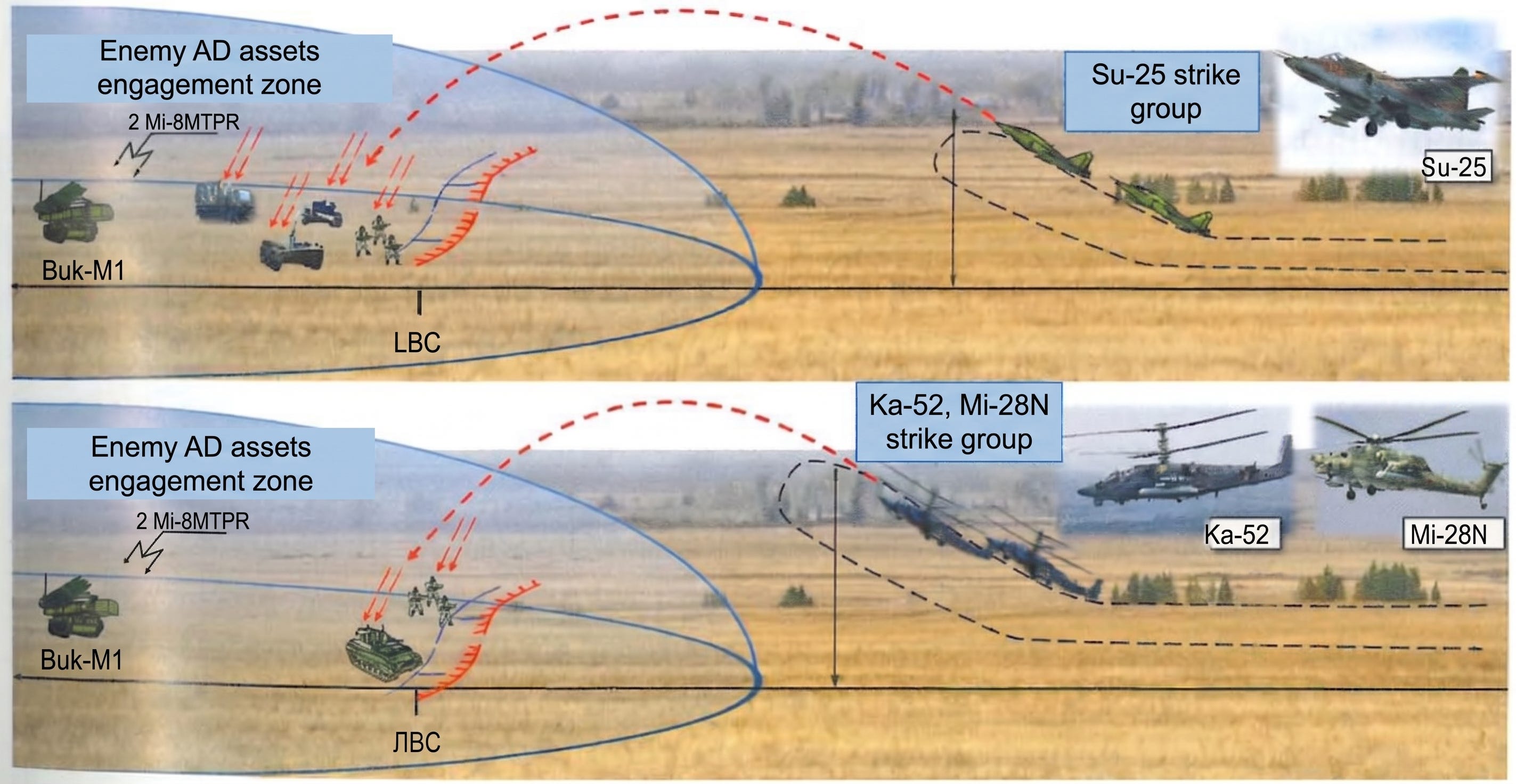
Unguided rockets are fired during a pull-up manoeuvre. The aircraft approaches at low altitude, climbs briefly to loft its rockets at maximum range, and then makes a descending turn towards home. Aircraft pass through in pairs, separated by intervals of several minutes.
The authors add that a new rocket with a penetrating high-explosive fragmentation warhead has extended the range of these attacks.
Helicopter packages operate in threes. A Ka-52 engages the target and uses its self-protection system to cover the formation. An Mi-28 provides additional firepower and protects the Ka-52 during its attack run. An Mi-8 remains available for search and rescue.
Against moving columns, the authors describe a method based on timing and fixed landmarks. Commanders identify bridges, crossroads, tree lines or other points that an advancing column is expected to reach between 60 and 90 minutes after setting out. The helicopters then fire from launch lines intended to keep them beyond the reach of man-portable and short-range air-defence systems.
Lofted rocket attacks of this kind have been documented since the first weeks of the war. What is unusual here is not the manoeuvre itself, but its codification: the timing method and the formal division of roles among the three helicopters have not previously appeared in Western reporting in this form.
The admission that matters
Afanasyev and his co-authors acknowledge one operational problem.
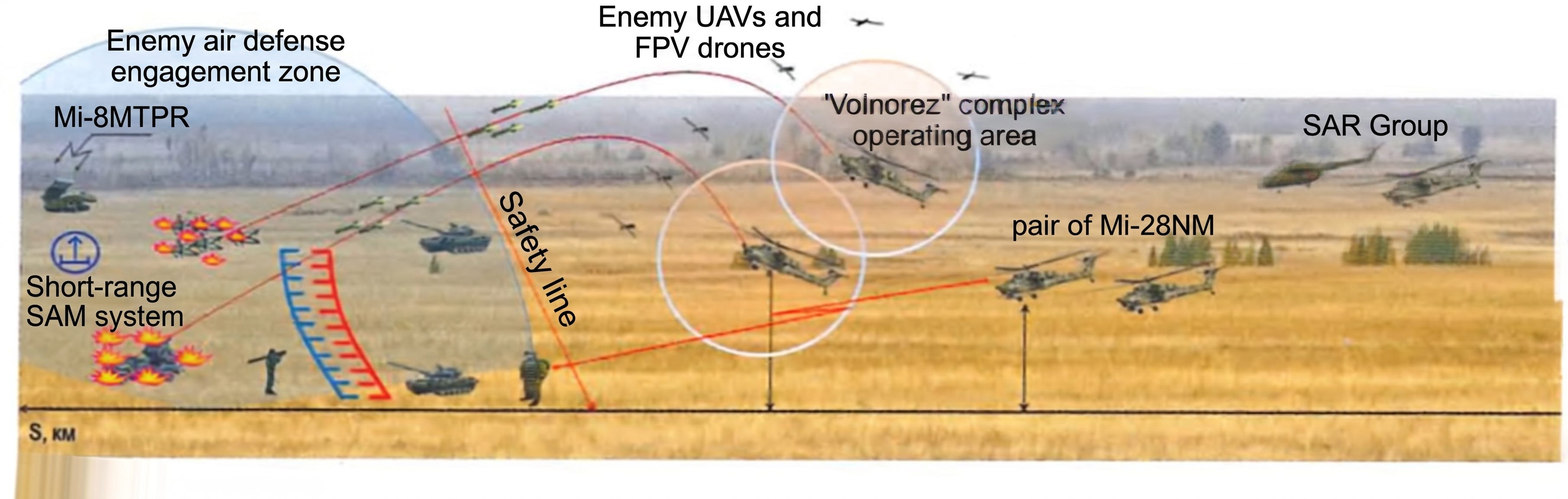
‘The enemy began to employ the tactic of engaging our helicopters in the air with unmanned aerial vehicles and FPV drones,’ they write, ‘in connection with which helicopter crews began to employ the Volnorez system.’
Volnorez is a compact electronic-warfare system first seen fitted to Russian tanks. It detects an attacking drone and suppresses the radio link used to control it. A helicopter variant has reportedly been undergoing trials since August 2024.
The article’s diagram depicts drones above the helicopters, the jammer’s protective bubble around the formation and a safety line running across the battlefield.
Yet the article says nothing about fibre-optic guidance.
On 20 March 2026, roughly four months after the issue went to press, Ukrainian forces recorded the first known destruction of a Ka-52 by a fibre-optic FPV drone near Pokrovsk. Such a drone is controlled through a thin cable and emits no radio signal. A radio-frequency jammer therefore has no control link to disrupt.
What the article reveals
Read as institutional evidence, the article captures a military lessons-learned process in motion. Front-line practices have been converted into categories, diagrams and recommendations, with a lag of roughly a year, and published in a journal intended for the General Staff’s own officers.
Whether those lessons alter behaviour at the front is a separate question, and not one that a journal article can answer.
All the tactics described point in the same direction. The glide-bomb release, the drone-designated missile, the lofted rocket attack and the helicopter launch lines are designed to keep aircraft outside Ukrainian air defence engagement zones.
Second, the authors regard both close air support aviation and army aviation as relevant even on a drone-saturated battlefield. The emphasis also suggests that they expect the air war to continue along familiar lines: Ukrainian air defences are to be avoided rather than systematically suppressed.
Drones are woven through almost every stage of this system. They conduct reconnaissance, illuminate targets for guided missiles and allow forward air controllers to direct attacks against moving columns. The one threat the authors openly acknowledge — FPV attacks on Russian helicopters — is also unmanned.
The article cannot, however, support broader conclusions about how widely these tactics are used, how effective they are, how many operational helicopters carry Volnorez or what now constitutes Russian doctrine. A single article marks one boundary of an internal military conversation; it does not define that conversation in full.
Two forms of evidence would strengthen the picture presented here: independent open-source confirmation of a drone-designated missile strike, and photographs showing Volnorez systems fitted to operational helicopters. Conversely, another successful fibre-optic drone attack on a Russian helicopter would further expose the limits of the proposed countermeasure.
Notes
Primary source: A. S. Afanasyev, A. A. Artemyev, A. N. Kochnev and P. E. Ivanov, ‘Improving the Tactics of Air Engagement of the Enemy in Modern Military Conflicts’ («Совершенствование тактики авиационного поражения противника в современных военных конфликтах»), Voyennaya Mysl, No. 11, 2025, read in translation. The 2024 article it cites is S. V. Dronov, G. A. Vasilyev and A. N. Kiryushin, ‘Specifics of Aviation Tactics in Modern Warfare and Ways for Its Improvement’, Voyennaya Mysl, No. 1, 2024, pp. 15–21; Dronov commanded the Russian Air Force from 2019 to 2024.
Images are translated by the author from the original Russian-language source.

Interesting article, points to the Russians having their own lessons learned.
Staff studies are good because it collects and acts on data also.
Thanks for sharing.
Exceedingly interesting reading and certainly filled in a few black spots in my knowledge. Appreciated, good work 👍