


By Juuso Eskonmaa
Mellenion
Introduction
“The use of unmanned aerial vehicles is one of the modern methods of conducting armed struggle, which adjusts all others, regardless of the service branch and branch of arms of the Armed Forces in whose interests they are used.”
– V.V. Putin
The Russian Navy’s performance in the Black Sea since February 2022 has been far worse than expected. The loss of the cruiser Moskva, a sustained Ukrainian drone and missile campaign against the Black Sea Fleet’s infrastructure and surface fleet, and the eventual withdrawal of naval assets from Sevastopol add up to a strategic failure. A fleet built for naval dominance could not operate freely even in its home waters.
These failures are now being closely analysed in Russia. Inside the Russian armed forces’ research establishments, they are generating a body of theoretical writing on what the experience reveals about the future of naval combat, and how the fleet must adapt.
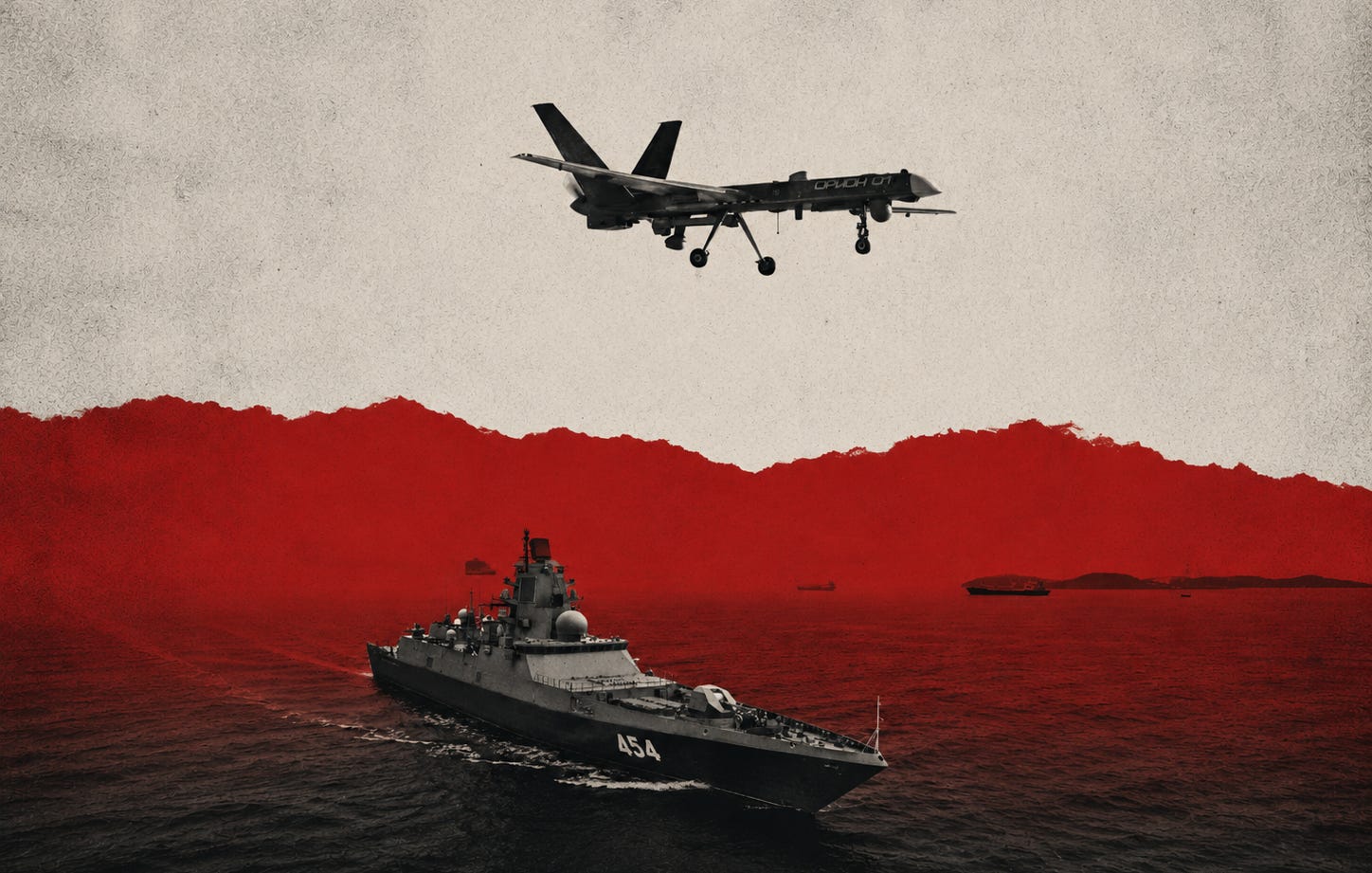
One of the most authoritative recent contributions has come from Admiral Nikolai Evmenov, in an article titled ‘The Use of Unmanned Aerial Vehicles in Modern Naval Combat’ (Применение беспилотных летательных аппаратов в современном морском бою), published in the Russian Ministry of Defence’s official naval journal, Morskoi Sbornik (Морской Сборник). His central claim is far-reaching: UAVs have not merely refined naval combat but transformed its content, and a fleet that means to compete must build its future combat model around unmanned systems.
Why Evmenov’s voice has authority
Evmenov served as Commander-in-Chief of the Russian Navy from 3 May 2019 to 10 March 2024, through the opening years of the full-scale invasion of Ukraine. He now heads the Admiral Kuznetsov Naval Academy (Военно-морская академия имени Адмирала Флота Советского Союза Н.Г. Кузнецова) in St Petersburg, Russia’s premier naval higher-education institution and a combined military training and research centre. The post gives him authority over both the education of naval officers and the direction of naval research – the two channels through which ideas become force structure, procurement, and doctrine.
He is also one of the most prolific writers on naval theory in contemporary Russia, a regular contributor to Voennaia mysl’ (Военная Мысль) and Morskoi Sbornik. Both are official Ministry of Defence publications, so appearances in them signal institutional legitimacy and acceptance for his views. Operational experience commanding the Navy at war, authority over naval education and research, and an established record of theoretical publication together give Evmenov an authoritative standing in the Russian naval community.
The changing substance of naval combat
Evmenov’s primary argument concerns the nature of naval warfare itself. He opens his article with the words of Vladimir Putin quoted above, and the choice is deliberate: Russia’s political and naval leadership appear to be converging on a single view, that unmanned systems are central to the future of war.
«совершенствование морского боя в современных условиях ведения боевых действий на море с использованием БПЛА будет заключаться не в изменении установленной организации действий сил (войск) в пространстве и во времени, а в изменении содержания морского боя»
The improvement of naval combat in modern conditions will consist not in changing the established organisation of forces in space and in time, but in changing the content (содержание) of naval combat.
The word содержание is doing the work here. It denotes the substance or content of naval warfare, not its outward arrangement: the change Evmenov describes is not an adjustment to how naval forces fight, but a change in what naval combat is.
He sets this against a recent past. Ten to twelve years ago, UAVs were confined to supporting roles – aerial reconnaissance, target designation, and battle damage assessment. They extended the capabilities of traditional naval forces but did not replace them.
That relationship has now reversed. UAVs have become a primary capability for completing combat tasks, including the destruction of enemy targets through direct fires and electronic suppression. Evmenov’s projection goes further still: tactical actions in naval combat will eventually be conducted exclusively by robotic and unmanned systems.
On this view, a fleet without sufficient UAVs does not merely lack specific capabilities; it faces significant disadvantages against an opponent whose formations and tactical units are measurably more effective in combat, and able to engage its opponents at longer ranges.
Global trends and the lessons of Ukraine
Two things shape Russian naval thought here: international developments, watched closely in Russia, and the experience of the war in Ukraine. Evmenov identifies six principal trends in UAV development among the leading countries:
- falling production costs, which improve overall cost-effectiveness;
- AI-enabled swarm control;
- closer integration of UAVs with manned aviation;
- an expanding range of tasks, up to the full replacement of manned systems;
- the development of air-, sea-, and ground-based launch platforms;
- and the emergence of hybrid UAVs able to operate across domains, such as air-land and air-sea.
From Ukraine he draws two principal empirical lessons. The first concerns situational awareness. Among the most consequential factors in combat is the commander’s knowledge of the situation, and in a fast-changing environment that knowledge must be supplied continuously and in real time; reconnaissance UAVs are among the primary means of providing it.
The second concerns targeting precision. The accuracy with which a target is located directly determines the effectiveness of a strike, and such precision is now within reach through reconnaissance drones combined with automated AI-assisted data processing and machine vision systems that identify priority targets and can correct fire against them in real time.
His most striking claim concerns the attacks on the Black Sea Fleet itself. The massed Ukrainian strikes, combining UAVs and unmanned surface vehicles against Black Sea Fleet basing points, were conducted, he states, with reconnaissance support from the US Navy’s strategic UAV, the RQ-4C Triton, operating within the American Broad Area Maritime Surveillance system (BAMS).
The acknowledgement is notable on two counts. First, a Russian admiral is stating, in an official MoD publication, that American strategic ISR contributed to the strikes that damaged and displaced his fleet. Second, he treats the Triton/BAMS architecture not as an accusation against the United States but as a model of the kind of persistent maritime surveillance the Russian Navy must build for itself.
A future force in three tiers
Evmenov argues that the Russian Navy needs a three-tier UAV architecture. At the top sit airfield-based strategic and operational-tactical reconnaissance-strike drones, flown by naval aviation as the fleet’s long-range, persistent surveillance and strike arm.
In the middle is a category that has drawn little notice in Western analysis: operational-tactical, ship-based vertical take-off and landing (VTOL) UAVs, again within naval aviation, able to redeploy onto ships equipped with helicopter decks. This intermediate tier bridges the fixed airfield component and the shipborne one, giving surface combatants longer-range aerial reach without dedicated carrier infrastructure.
At the tactical, unit level, ships carry fixed-wing and rotary-wing tactical UAVs, loitering munitions, and FPV drones. Evmenov even envisages light tactical UAVs for submarines, launched from containers deployed through the torpedo tube.
Crucially, he states that the Russian Navy is already executing a plan (осуществляется план) to equip surface ships and coastal defence units with UAVs of various classes, and that UAV units of different types and designations are already being formed within naval aviation. The inclusion of coastal defence troops matters: the effort reaches beyond the fleet’s ships to the Navy’s land-based coastal defence arm.
Evmenov’s near-term priority is to raise the strike and reconnaissance capabilities of existing UAV systems, and to integrate artificial intelligence into naval command systems. The immediate programme for the surface fleet is an operational-tactical UAV system built around a ship-based VTOL UAV. The medium-term objective is more ambitious: a fixed-wing reconnaissance-strike UAV at the strategic and operational-tactical level, intended as a key future strike capability. Further ahead, he identifies anti-submarine warfare, transport, and special tasks as the next areas of expansion.
A vision for the future - not yet capability
This is not a speculative essay. It is a doctrinal argument, made by the head of Russia’s leading naval academic institution in the Ministry of Defence’s official journal, and drawing on the operational experience of the Navy that Evmenov himself commanded through the opening years of a war that taught it the painful lessons of modern naval warfare. The claim that UAVs are transforming the substance of naval combat may signal a coming reform of the Russian Navy.
The medium- and longer-term ambitions show its scope. UAVs are to expand across a widening range of Navy missions, above all in reconnaissance and strike: persistent surveillance of maritime and coastal areas, and an increase in the number of available sensors. They are also to expand the quantity and the types of strike assets the fleet can field, with coastal troops and naval aviation taking a larger part in naval combat as long-range strike assets grow within their organizations.
The planned move into anti-submarine warfare would extend unmanned aviation into the undersea domain. Taken together, these point to a Navy that is not bolting UAVs onto an existing force structure but rethinking how the fundamental tasks of naval forces are to be done, with traditional capabilities taking a secondary role in many respects.
It should be noted that Evmenov does not assess whether the Russian Navy can translate this doctrine into operational capability under sanctions, and amid the industrial demands of an attritional war. That is the question that matters, and the one we will keep watching. ֍

…it’s too little too late, not to mention that it’s all just stating the facts ukraine is already in a process of producing
Look at what drones have done to the American Navy, the most mighty Navy in human history in the Gulf. During the hot phase they kept their ships 1000km(!) away from Irans coast.