


By Juuso Eskonmaa
Mellenion
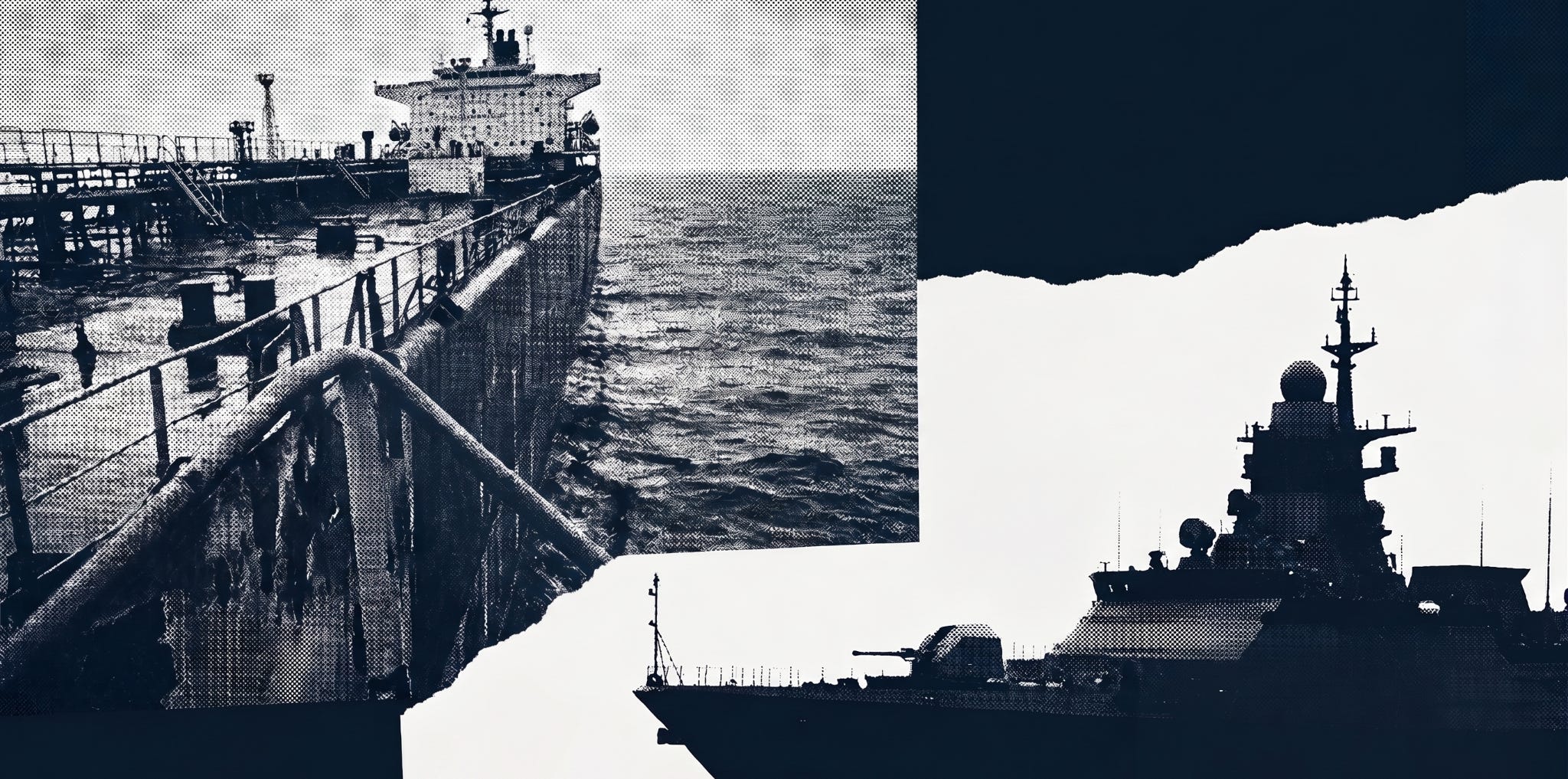
Russia’s shipping in the Baltic Sea has been severely disrupted. In recent weeks, dozens of Russia-linked tankers were stranded in the narrow Gulf of Finland as a result of repeated Ukrainian strikes on the Russian oil terminals at Ust-Luga and Primorsk. The terminals are critical for Russia’s oil exports. Together they handle nearly half of Russia’s oil exports, including both crude and refined products.
Estonian Navy Commander Ivo Värk recently stated that Estonia will not apprehend vessels remaining in its Exclusive Economic Zone, because “the risk of military escalation is just too high.”
Members of the G7 and the European Union have imposed a wide array of sanctions on Russian energy exports as a result of Russia’s invasion of Ukraine. European coastal states have boarded, detained, or seized Russian-linked vessels on varying legal grounds: suspected sailing under a false flag; inadequate seaworthiness in an ageing shadow fleet; missing or inadequate insurance and flag documentation; environmental protection concerns; and criminal investigations into sabotage or espionage, which have repeatedly led to the discovery of sanctions violations once inspectors are aboard.
Estonia’s restraint reflects rising tensions across the Baltic. Russia has responded to the sanctions enforcement pressure with increasingly overt military signalling. In May 2025, after the Estonian Navy attempted to intercept a sanctioned unflagged vessel that refused to stop and began trailing it, Russia deployed a Su-35 fighter jet to prevent the seizure, violating Estonian airspace in the process.
Over the past year Russia has built a comprehensive military posture to protect its shipping in the region and across its narrow maritime approaches. This posture combines naval escorts, the deployment of fighter aircraft, armed personnel aboard Russia-linked vessels, and a continuous information campaign in support of the measures. Ongoing legal changes are also creating additional pretexts for the use of military force. The hardening posture has raised the risks of intercepting Russia-linked ships.
Emerging Militarisation of Russian Merchant Shipping
Presidential aide and head of the Russian Maritime Collegium Nikolai Patrushev has been the most active Russian official speaking publicly on the protection of shipping, with regular statements from spring 2025 onwards. He has described the need to maintain naval presence on primary maritime trade routes, including in distant maritime zones, on a continuous basis.
Russia argues that any blockade attempt would be illegal under international law and dismisses the “shadow fleet” label as a “legal fiction”. On this basis, Patrushev has threatened that “a blockade would be broken and liquidated by the Russian Navy.”
On 26 May 2025 it was announced that the Russian Maritime Collegium had prepared measures to prevent restrictions on shipping in the Baltic, but the measures were not made public at the time. Almost a year later, on 25 March 2026, Patrushev publicly announced a list of measures to improve the protection of Russian shipping in key maritime routes:
A standing procedure for “operational interaction” between shipping companies, port operators, and the Russian Navy, covering primarily the Baltic Sea and the Black Sea. This format establishes a direct connection between the commercial operators, Russian port administration, and the Russian Navy.
The Navy is tasked with protecting designated vessels and assets and with maintaining continuous presence across defined maritime areas, while standing ready to respond to incidents. This protection applies to vessels carrying Russian cargo regardless of whether they sail under the Russian flag.
A process for shipowners to request, through port captains, the placement of mobile fire teams aboard Russian flagged ships. Mobile fire teams (мобильные огневые группы) typically refer to air defence units with light weaponry. They would be intended to act as a deterrent against boardings by helicopters as well as an anti-drone capability.
Taken together, these measures indicate formal, standing procedures for the protection of shipping with military force. Earlier escort and protection activity was likely improvised; the new processes are embedded in the shipping bureaucracy, with port administrations acting as an important point of contact. The most consequential development is the possibility of placing anti-aircraft-capable teams on vessels sailing under the Russian flag. If implemented, this would shift the deterrence calculus for boarding Russian flagged commercial ships.
The Limits of Russian Naval Escorts
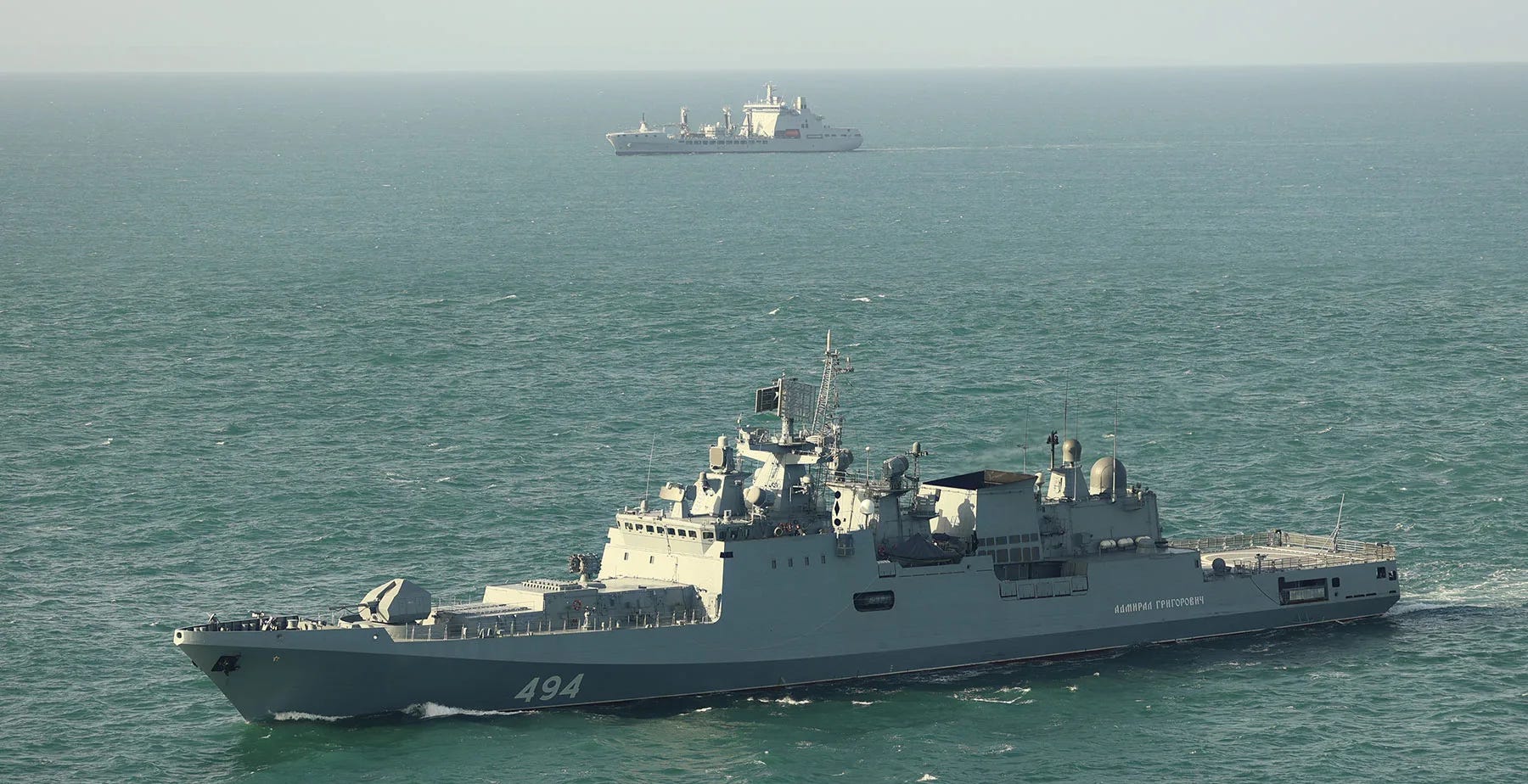
Russia’s capacity to escort merchant ships with Navy vessels is limited and geographically constrained. Retired Vice-Admiral Ulyan Bayzert, former deputy commander of the Russian Northern Fleet, argues in Kommersant that occasional escorts of Russian merchant vessels do not solve the problem. He claims that the Russian Navy is physically incapable of providing regular convoy protection. In the Baltic Sea, regular escorts would be possible only as far as the Danish Straits, after which vessels would be left without protection. A corvette can operate autonomously for only a month, and a small missile ship for only ten days. Russian escorts therefore cannot reliably or regularly operate in the Atlantic to protect shipping.
The less costly alternative has been to place armed personnel aboard Russian merchant ships. The Organised Crime and Corruption Reporting Project recently published information about Russian protection teams operating on tankers carrying Russian energy products. By examining crew manifests, the investigation found that such tankers often carry two additional Russian men aboard, many of whom have connections to Russian security services or private military companies. Armed uniformed personnel aboard Russia-linked vessels were first publicly confirmed by the Swedish Navy in December 2025.
A New Legal Pretext for the Protection of Shipping
Russia is adapting its legislation to permit the use of military force abroad to prevent the arrest, detention, and prosecution of Russian citizens. On 14 April, the Russian Duma passed at first reading a legislative amendment that authorises the Russian Armed Forces to operate abroad and use military force, on the decision of the President, to protect Russian citizens abroad. Although comparable provisions already exist in Russian legislation, the new amendment focuses on cases of arrest, detention, and criminal or other proceedings by foreign states.
The provided legal documentation gives no specific reasons for the changes, nor any examples of cases to which the legislation would apply. Russian legal expert Ilya Rachkov, interviewed by Kommersant, assessed that the legislation would apply to the protection of Russian commercial vessels and other transport assets placed on sanctions lists. He envisions a case in which foreign border guards board a vessel carrying Russian cargo and arrest its crew. In such a case, Rachkov said, the Russian Armed Forces could be deployed, provided that “they receive the relevant order from the President”.
On 22 April, the Russian Ministry of Transport announced that up to 1,000 vessels could be transferred to the Russian flag. The Ministry claims that the total tonnage sailing under the Russian flag has more than doubled to nearly 20 million tons over the past two years and may reach 30 million tons by the end of 2026. The vessels to be transferred are mainly large tankers, and the Ministry presents reflagging as a “safer” option, since the state gains a broader range of options to protect shipping under its jurisdiction. The Ministry framed the transfer as a response to the targeting of vessels that carry Russian cargo but do not fly the Russian flag.
The reflagging initiative and the new legal pretexts for the use of military force are likely connected elements of the militarisation of the Russian merchant fleet. The legislation provides legal grounds for the use of military force abroad to protect Russian citizens, including in cases of arrest made by foreign authorities boarding vessels that carry Russian cargo.
The flag transfer expands the number of vessels to be partly crewed by Russian citizens and operating under Russian jurisdiction, effectively broadening the category of cases in which the Russian authorities could use military force to protect shipping. Together, the legal changes and the flag transfer are likely intended to act as a deterrence mechanism against the seizure of ships, substituting for the Russian Navy’s insufficient capacity to escort vessels evading sanctions.
Concluding Thoughts
The Russian authorities appear to have concluded that the covert sanctions evasion regime no longer provides sufficient cover for Russian energy exports. There is an ongoing shift towards a more overt and militarised posture to protect ships evading EU and G7 sanctions. This presents a direct challenge to the enforcement of sanctions. Russia has engineered an escalation trap: the boarding of Russian ships may increasingly be met with armed resistance and a Russian naval response.
Over the coming six months, further transfers of tankers to the Russian flag and continued militarisation of the merchant fleet are likely. Armed personnel and mobile fire teams aboard Russian ships should be expected with growing frequency. Despite its limitations, Russia is likely to increase the number of naval escorts in the Baltic Sea, the North Sea, and the English Channel. The legislation on the protection of Russian citizens abroad has not yet completed its parliamentary passage; if it does pass, it will provide a wider legal pretext for the use of force and a basis for more threatening rhetoric from the Russian side.
The announced Russian measures should be read as stated intentions, but their implementation faces constraints. The expansion of Russian naval escorts and the maintenance of continuous readiness on the high seas demand substantial resources from the Russian Navy and its crews, which will likely be a central limiting factor.
Mobile fire teams aboard ships may offer protection against helicopter boardings and drones, but Russia’s air defences are already increasingly stretched, and arming the merchant fleet would compete with air defence requirements on Russian territory. In addition, even if the number of ships sailing under the Russian flag increases significantly, the number of Russian citizens among crew members is unlikely to rise given the limited supply of Russian seafarers.
We are likely to see a more militarised Russian merchant fleet with uneven implementation reflecting the resource constraints. Escalation risks in sanctions enforcement will rise as Russia's rhetoric hardens and military measures are implemented to defend its shipping. ֍

…i’m sure Zelenskyy can and already know what to do then