


By Andreas Turunen
Mellenion
Introduction
Early observations from the war between the United States and Iran have again demonstrated the effectiveness of one-way attack unmanned aerial systems (OWA UAS). In this conflict, OWA UAS platforms have been employed against U.S. military installations located on the territory of their Middle Eastern allies. Iran’s use of OWA UAS, particularly its Shahed-drone, has been extensive, with the United Arab Emirates alone reportedly facing nearly 500–700 OWA strike drones directed at vital targets on its soil.
If this trend continues over the course of the war, the Western analytical community can say with increasing certainty that long-range strike drones will remain a consistent element of modern warfare.
In a previous article, I examined Russia’s limitations in achieving aerospace dominance in a hypothetical scenario in which Russia invades the Baltic States. In this piece, I turn to what may be the most obvious strength in Russia’s inventory: the use of long-range strike UAVs. These systems are costly to intercept, difficult to destroy on the ground, and capable of causing significant damage when they reach their targets. Their effectiveness is particularly consequential against vulnerable objectives such as critical civilian infrastructure.
The conduct of long-range drone warfare
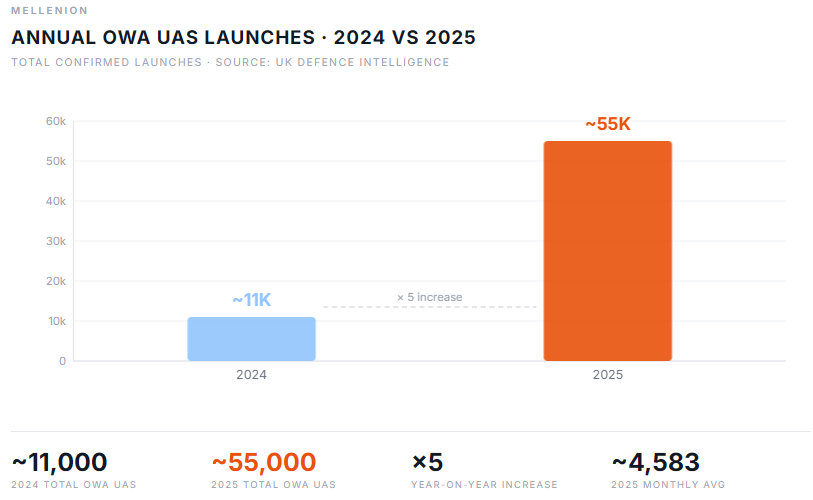
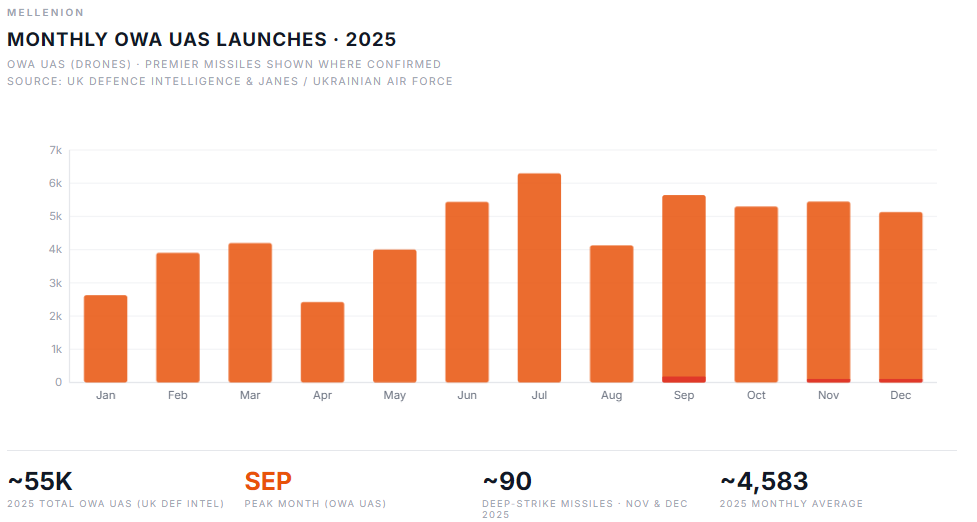
In Ukraine, Russia has employed Geran-drones (the Russian version of the Iranian Shahed) on a large scale to degrade Ukraine’s military and civilian infrastructure. According to British military intelligence, Russia launched 55,000 OWA UAS during 2025. This represented a five-fold increase in the use of OWA UAS compared with the previous year, 2024.
The Western approach to conducting air and missile defence traditionally treats interception as a measure of last resort. Defensive systems are expected to engage incoming threats only if the adversary’s strike systems have not been destroyed on the ground prior to launch.
For Ukraine, achieving such ground kills against the Geran OWA UAS has proven difficult. This constraint stems largely from Ukraine’s inability to achieve aerospace supremacy and to develop an air-to-ground strike capability sufficient to degrade the launch platforms of long-range strike drones on the ground.
In the war in Ukraine, the proliferation of long-range strike drones became widespread largely because Russia was unable to achieve air supremacy. Therefore, Russia had to increase its long range drone strike capability. As a result of the extensive use of OWA UAS by Russia, Ukraine has developed one of the most sophisticated and layered approaches to countering the threat to its critical infrastructure. This approach also incorporates a range of improvised and adaptive methods, including the use of helicopters, fighter aircraft, electronic warfare, and interceptor drones.
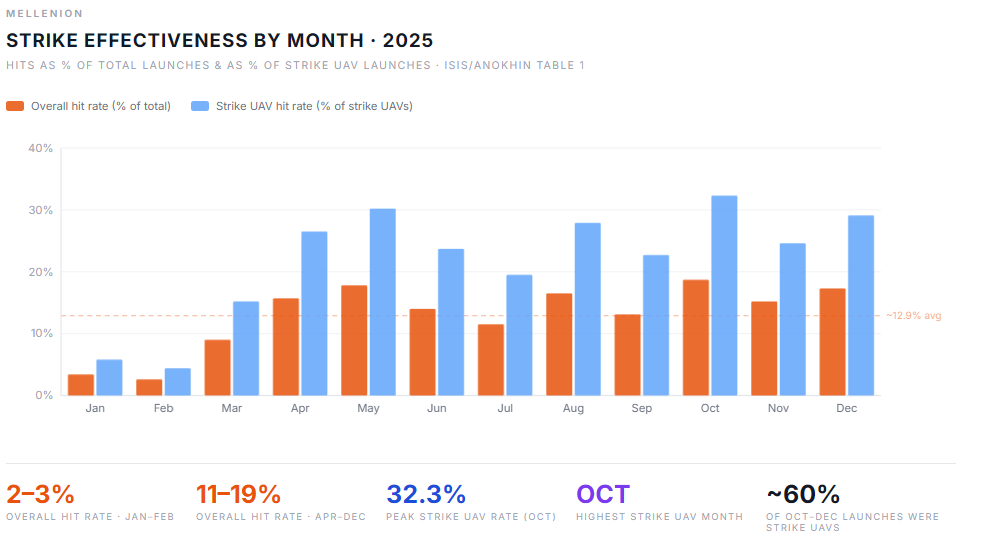
Achieving a near-total interception rate against Russian long-range OWA UAS drones presents a considerable challenge for Western militaries for several reasons:
The very long operational range of the Geran-2 system, estimated at 1,800–2,500 kilometres, makes it difficult for Western air forces to destroy these systems on the ground on a sufficient scale.
The relatively small size, manoeuvrability, and rack-based launch platforms make the Geran system difficult for Western ISR units to locate.
Russia possesses considerable strategic depth, allowing it to conduct well-concealed launches and to disperse launchers effectively across its territory.
The difficulty of intercepting Shahed-Geran-type drones has reportedly also been acknowledged by officials in the US administration. According to CNN, US interception systems are not capable of intercepting all incoming drones because their flight characteristics make them more difficult to counter than ballistic missiles in certain circumstances.
Assessment
In Ukraine, Russia has degraded the country’s overall energy production through sustained and massed long-range strikes, the majority of which have been conducted using long-range OWA UAS drones.
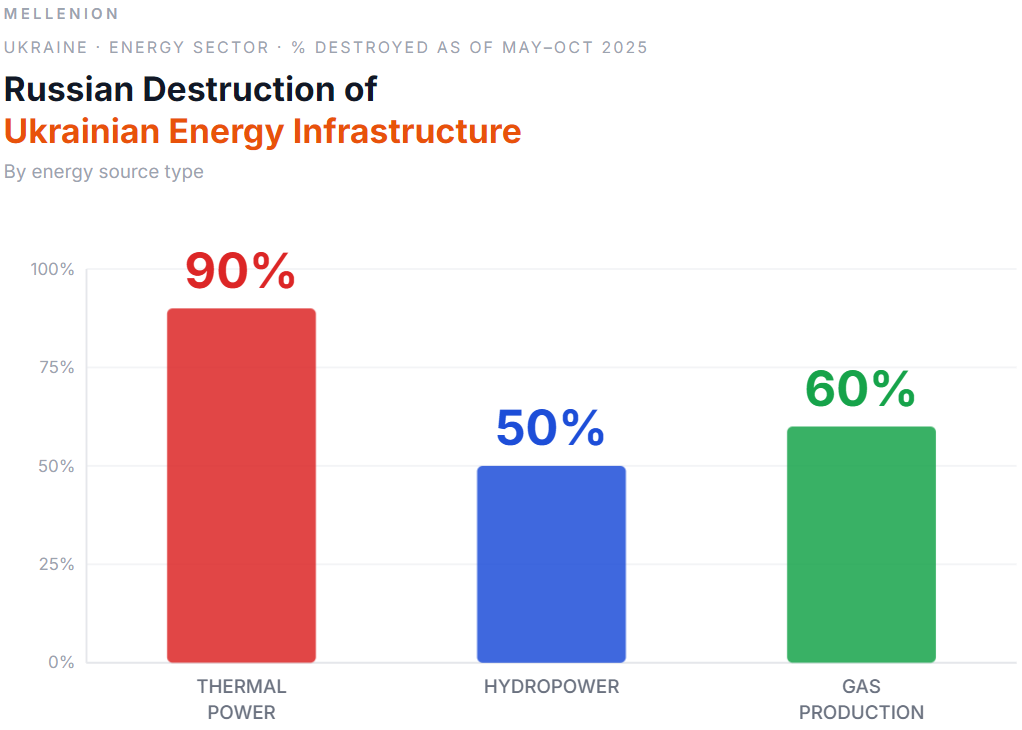
In a war against Russia, European critical infrastructure and industrial facilities would be vulnerable to a sustained and massed long-range strike drone campaign. This vulnerability extends across the spectrum of critical infrastructure, meaning that most critical infrastructure could be targeted, unless located underground.
These include:
Energy systems: generation (thermal and hydro), transmission and distribution infrastructure (substations, transformers, and lines), as well as gas and oil nodes.
Water and municipal services: water supply systems, district heating networks, and other essential services tied to utilities.
Transport, logistics, and connectivity: railways, ports and grain-export infrastructure, logistics hubs, telecommunications and digital networks.
The effects of targeting critical infrastructure are societal and, in wartime, are intended to erode the will of the population to resist. To mitigate this threat, European countries and businesses have the advantage of being able to observe and learn from Ukraine’s layered counter-drone defence.
For Russia, long-range strike drones have become an essential component of modern warfare. Russian strategy seeks to degrade Ukraine’s military and economic potential through widespread attacks against critical infrastructure and military targets. This approach is intended to force Ukraine’s capitulation and subjugation to Russian political objectives. In any future conflict involving another European state, it is reasonable to expect that this approach will be repeated and further developed. The threat should therefore be regarded as persistent. ֍

One additional point is the defense economics: if a ~$20k one-way drone routinely draws a ~$500k interceptor, defenders lose the cost war even with good tactical performance.
Defenses need to be cost effective. This means no more Alert-5 style interceptions and more drone defense tech like EW bubbles around targets, drone-on-drone, kinetic defense (lasers!).
Even putting up a "cope cage" around a small electrical substation (I'm kinda joking here...) is already something.
The interesing part is that the technology for this is already here. The doctrine as well - NATO's IAMD already defines the needed parts. Too bad we are not that good at executing the changes, but then again, we're not under constant bombardment from Russia day-to-day.